Ten people linked to Kenya's first-ever Ebola case quarantined as screening concerns grow - BBC
This story deserves to be shared
Send it to someone who'd care, or post it on your networks.
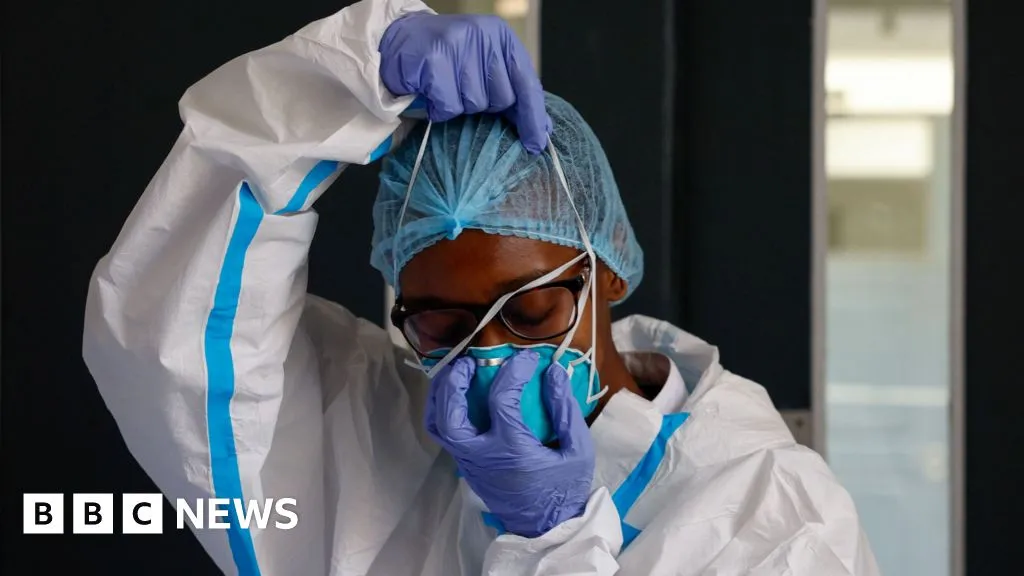
7 October 2026Basillioh RukangaNairobiReutersThose placed at the Ebola isolation facility are under constant observationTen people who came into contact with a man who died of Ebola in Kenya have been quarantined, health officials in the East African nation say. They are also trying to trace 57 other contacts of the Kenyan patient after he travelled from the Democratic Republic of Congo, dying in hospital in Nairobi on Monday. This is the East African nation's first-ever Ebola case and there is now growing concern about the country's screening measures. The Africa Centres for Disease Control and Prevention chief has told the BBC that despite being sick for a month, the patient passed through multiple cities in DR Congo, driving to Uganda and eventually flying to Kenya without his sickness being detected. "We know that he left Buta, a city in [northern] DR Congo, to drive to Kisangani. And from Kisangani, he took a flight to Beni. From Beni, he drove to Uganda. And from Uganda, he took a flight to Nairobi," Jean Kaseya told the BBC's Focus on Africa programme. "What are symptoms he was presenting? Why was he not detected? " he asked.
This article is an excerpt. To read the full content, visit the original source. BBC
Related articles

Continuous glucose monitors help type 2 diabetes patients spend 5 more hours a day in healthy blood sugar range - Medical Xpress
Continuous glucose monitors (CGMs) could transform diabetes management for millions of Americans with type 2 diabetes who don't take insulin, according to findings published in the New England Journal of Medicine. The clinical trial found that adults using CGMs spent approximately five additional hours each day within their target blood sugar range compared with those receiving routine care. Nearly twice as many CGM users also achieved an A1c level below 7%, a common treatment goal for people with diabetes.
Wearing headphones during surgery may reduce nausea and vomiting afterward - Medical Xpress
Patients who wore noise-canceling headphones during minimally invasive gynecological surgery were significantly less likely to experience postoperative nausea and vomiting (PONV), suggest findings from a randomized clinical trial presented at the Anesthesiology 2026 annual meeting.

Kefah Mokbel: Can Whole-Genome Sequencing-Based ctDNA Monitoring Help Personalize Adjuvant Treatment? - Oncodaily
“Beyond Detecting Cancer Recurrence: Can Whole-Genome Sequencing-Based ctDNA Monitoring Help Personalize Adjuvant Treatment? An exciting new study published in The Oncologist highlights the clinical potential of Signatera Genome, a whole-genome sequencing (WGS)-based, tumor-informed circulating tumor DNA (ctDNA) assay, not only for detecting molecular residual disease (MRD), but also for potentially informing adjuvant treatment decisions.
0 comments
No comments yet. Be the first to share your thoughts!