Student Teams Begin Plans To Repurpose and Recycle Energy Technologies - nlr.gov
This story deserves to be shared
Send it to someone who'd care, or post it on your networks.
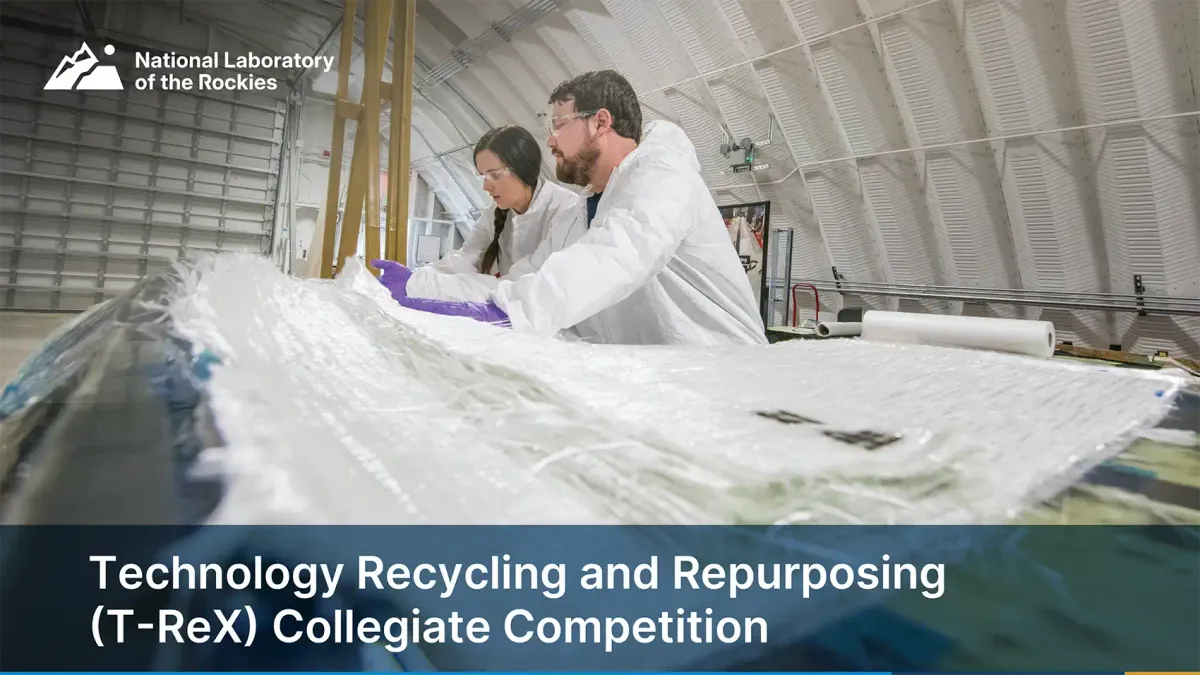
33 Collegiate Teams Start Phase 1 of Academic Competition That Will Unlock Value From Decommissioned Energy Technologies
The inaugural Technology Recycling and Repurposing Collegiate Competition has kicked off with 10 student teams participating in Phase 1, which takes place October–December 2026. Graphic by National Laboratory of the Rockies There’s a crisp scent in the air, leaves are falling from trees, and professors are lecturing in classrooms. For some students returning to their college campuses for the 2026–2027 academic year, one unique project has already kicked off, inspiring them to brainstorm solutions to a national challenge. Phase 1 of the National Laboratory of the Rockies’ Technology Recycling and Repurposing (T-ReX) Collegiate Competition, which takes place in the fall semester, invites teams to develop a way to recycle or repurpose retired energy technologies. The proposed processes or products could help address a growing issue in the United States as fleets of energy-generating devices and related energy-project infrastructure reach the ends of their service lives.
This article is an excerpt. To read the full content, visit the original source. nlr.gov
Related articles
Russian scientists develop method to recycle solar panels into silicon carbide - TV BRICS
Scientists from Tomsk Polytechnic University and Sevastopol State University have developed a two-stage method for recycling end-of-life solar panels to produce silicon carbide, a valuable material used in power electronics, ceramics and other industrial applications. This was reported on the website of the Ministry of Science and Higher Education of the Russian Federation. Photovoltaic modules typically operate for 20–30 years before reaching the end of their service life. They contain multiple materials, including glass, aluminium, silicon, copper and polymers, making their recycling a complex process. The new method enables the recovery of silicon-containing materials and their conversion into silicon carbide, which is valued for its hardness, heat resistance, corrosion resistance and high thermal conductivity.

No V12 Required: Argentina's Mid-Engine Supercar Packs An American V8 Punch - CarBuzz
Classic gems, tasteful customs, legendary supercars - for Silvian, they're all fair game. He's been in love with cars and motorcycles for as long as he can remember, so it made perfect sense to eventually turn that passion into a full-time writing career. Around six years and more than 3,000 articles later, he is still going strong and doesn't plan on hitting the brakes anytime soon. Argentina is a country known for its natural beauty, soccer legends, and chainsaw-wielding president, but it probably isn’t the first place you’d expect a rad V8 supercar to be developed. However, that assumption might change once you learn about a company called Valtor, the brainchild of engineer-turned-CEO Sergio Arias. He leads a small but ambitious team of designers and engineers like himself, who’d previously caught people’s attention with the Azor GT concept last year. Now they’re back at it once again with the Eaglon, an evolution of the Azor and something that could easily be mistaken for a Ferrari by those who don’t know their automotive lore.

Game developers cancel upcoming public demo out of fear of AI copycats - Mashable
There's currently some tension between the video game industry and the proliferation of AI tools. You can see the evidence of this in a recent development regarding the upcoming indie game Drunken Goddess Reflux. It's a game with the objective of imbibing alcohol until a demon vomits up her soul, a decidedly unique premise that would be hard for any AI to come up with. As spotted by Rock Paper Shotgun, though, the developers had to cancel an upcoming public demo session. The decision is partly due to concerns that AI could quickly clone it for someone else's financial benefit. Instead, they will hold closed sessions for a "limited number of participants. "

Slack Unveils Work Object Embeds for Seamless In-Thread Collaboration - Small Business Trends
In an era where time is money, small business owners constantly seek ways to streamline operations and enhance productivity. Recognizing this need, Slack has unveiled its latest feature: Work Object Embeds. This innovation allows users to bring live, interactive content directly into Slack conversations, eliminating the common hassle of constantly switching tabs and losing the flow of discussion. Work Object Embeds facilitate a seamless interaction within Slack by integrating tools and platforms that businesses may already rely on. When a team member shares a link from a supported application—be it a document, data analytics tool, or presentation software—it opens as a live and interactive piece of content directly in the conversation thread. This feature aims to keep discussions centered around the task at hand, enhancing collaboration across different team functions.
0 comments
No comments yet. Be the first to share your thoughts!