Scientists calculate how much information exists in the observable universe - The Brighter Side of News
This story deserves to be shared
Send it to someone who'd care, or post it on your networks.
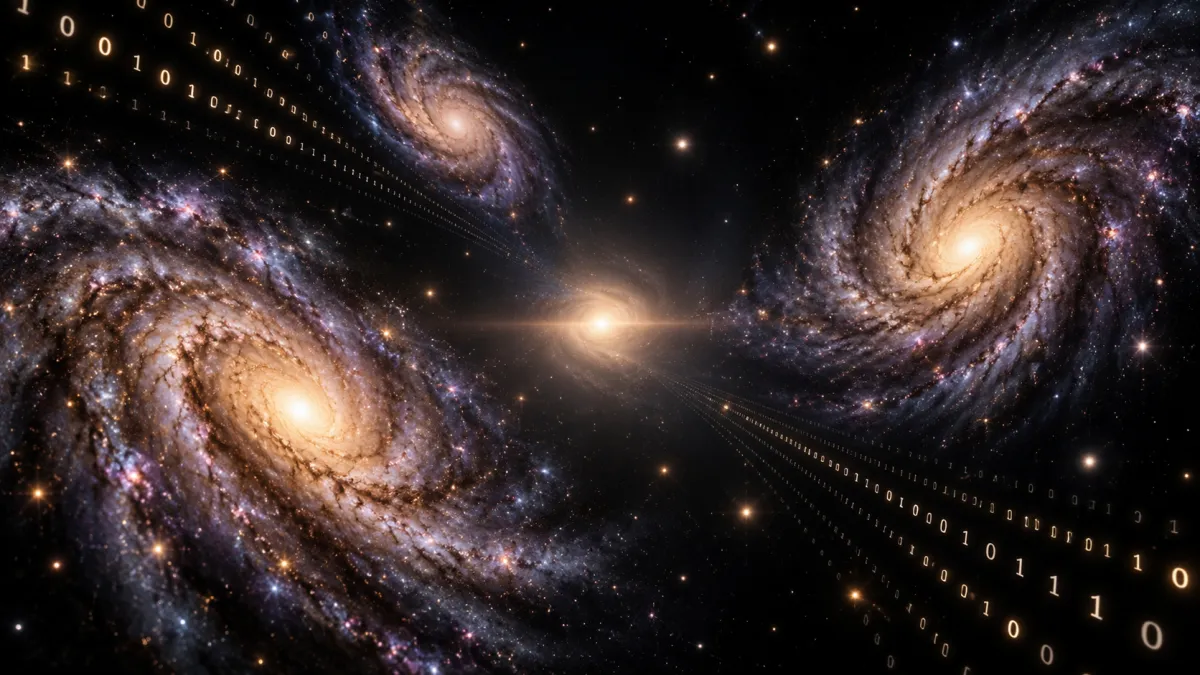
A theoretical calculation estimates roughly 6 × 10⁸⁰ bits of information in selected ordinary-matter particles across the observable universe. The model applies Shannon information theory, assigning an average of 1.509 bits to the particle categories it considers. The study excludes several components and does not establish that information is a new state of matter. An electron’s mass, charge and spin help distinguish it from other particles. Those identifying properties also raise a question: could matter itself be treated as a store of information, and could its information content be counted? The calculation offers one approach to a longstanding problem, rather than a measurement of everything the universe contains. Its result depends on how information is defined, which particles are counted and assumptions about where information can reside. Dr. Melvin Vopson of the University of Portsmouth's School of Mathematics and Physics. (CREDIT: University of Portsmouth) An information count built from particle identityMeasuring an electron’s characteristic properties allows an observer to identify it.
This article is an excerpt. To read the full content, visit the original source. The Brighter Side of News
Related articles

'I won't trust AI': Readers share mixed reaction to AI tools that calculate people's biological ages - Live Science
Scientists have developed AI tools to measure a person's true "biological age." Live Science asked readers whether they would be comfortable using these tools.

Would you trust AI to calculate your true 'biological age'? - Live Science
Scientists have developed various AI tools to measure people's biological ages. Would you use one?

Simulations explore nuclear mitigation of asteroid threats - Phys.org
Lawrence Livermore National Laboratory researcher Isaiah Santistevan led the development of three-dimensional simulations exploring how a nuclear device could deflect or disrupt an asteroid threatening Earth. Credit: Blaise Douros/LLNL Lawrence Livermore National Laboratory (LLNL) researchers are developing three-dimensional simulations to examine how a nuclear device could be used to deflect or potentially disrupt an asteroid threatening Earth.

A Black Hole 12,000 Light-Years Away Is Firing a Plasma Jet Toward Earth - Gadget Review
Milky Way’s first microblazar candidate sits 12,000 light-years away, offering a rare ground-level lab for studying relativistic jetsA black hole 12,000 light-years away is firing a jet of plasma almost directly toward Earth. At that distance, no known or expected danger to Earth has been identified by the researchers or the institutions involved. What astronomers have actually found is rarer and more interesting than a threat. Researchers have identified IRAS 18293-0941 as a compelling candidate for the Milky Way’s first microblazar, a class of object that gives astrophysicists a close-up laboratory for studying some of the most violent physics in the galaxy. What Astronomers FoundThe discovery centers on a binary system whose black hole expels plasma jets at close to three-quarters the speed of light, pointed almost directly toward Earth. The system pairs a hot, massive star with a black hole that completes a full orbit roughly every 11.38 days. Material drawn from the companion star feeds the black hole, and some of that matter gets expelled outward as opposing jets traveling at approximately three-quarters the speed of light. Terminology matters here.
0 comments
No comments yet. Be the first to share your thoughts!