Materials-AI Bidirectional Innovation - Nature
This story deserves to be shared
Send it to someone who'd care, or post it on your networks.

The relationship between artificial intelligence and materials science is increasingly bidirectional. AI is transforming how we discover, design, and optimize materials, while materials science is simultaneously reshaping the hardware on which AI depends. This Collection captures this bidirectional innovation through the lens of algorithms, platforms, and workflows that enable AI to accelerate materials researchand the materials that, in turn, expand what AI can achieve.
Materials science is undergoing a paradigm shift driven by advances in AI and their application to autonomous materials science platforms. The advances in AI are accelerating materials discovery, design, and synthesis through predictive modeling, generative approaches, and autonomous experimentation. Key developments include AI models trained on diverse datasets from high-throughput computation and experimentation; multimodal and generative AI for novel materials and synthesis routes; and autonomous materials science that combines AI/ML with automated laboratories, real-time data analysis, robotic experimentation, and adaptive characterization.
This article is an excerpt. To read the full content, visit the original source. Nature
Related articles
An enhanced TOGI-based control framework for seamless bidirectional energy management in grid-connected solar PV–EV charging systems - Nature
We’re sharing this article early to provide faster access to peer-reviewed, accepted research. It is citable and carries a permanent DOI. This version is subject to further edits and will be replaced automatically by the final Version of Record. All legal disclaimers apply. AbstractThe less cost of photovoltaic (PV) modules and the rapid growth of electric vehicles (EV) has accelerated the adoption of solar-powered charging systems. Despite this progress, the use of bidirectional power flow in PV–EV integrated charging infrastructure has received comparatively less attention. An enhanced third order generalized integrator (ETOGI) is utilized to control bidirectional voltage source converter (VSC). A comparison is made between the Selective Harmonic Elimination Pulse Width Modulation (PWM) and Phase Disposition Pulse Width Modulation methods to find the performance of the system based on total converter losses and harmonics. The suggested model is implemented and analysed in Simulink environment and further tested through real-time implementation by a real-time OPAL-RT test platform.

A Black Hole 12,000 Light-Years Away Is Firing a Plasma Jet Toward Earth - Gadget Review
Milky Way’s first microblazar candidate sits 12,000 light-years away, offering a rare ground-level lab for studying relativistic jetsA black hole 12,000 light-years away is firing a jet of plasma almost directly toward Earth. At that distance, no known or expected danger to Earth has been identified by the researchers or the institutions involved. What astronomers have actually found is rarer and more interesting than a threat. Researchers have identified IRAS 18293-0941 as a compelling candidate for the Milky Way’s first microblazar, a class of object that gives astrophysicists a close-up laboratory for studying some of the most violent physics in the galaxy. What Astronomers FoundThe discovery centers on a binary system whose black hole expels plasma jets at close to three-quarters the speed of light, pointed almost directly toward Earth. The system pairs a hot, massive star with a black hole that completes a full orbit roughly every 11.38 days. Material drawn from the companion star feeds the black hole, and some of that matter gets expelled outward as opposing jets traveling at approximately three-quarters the speed of light. Terminology matters here.
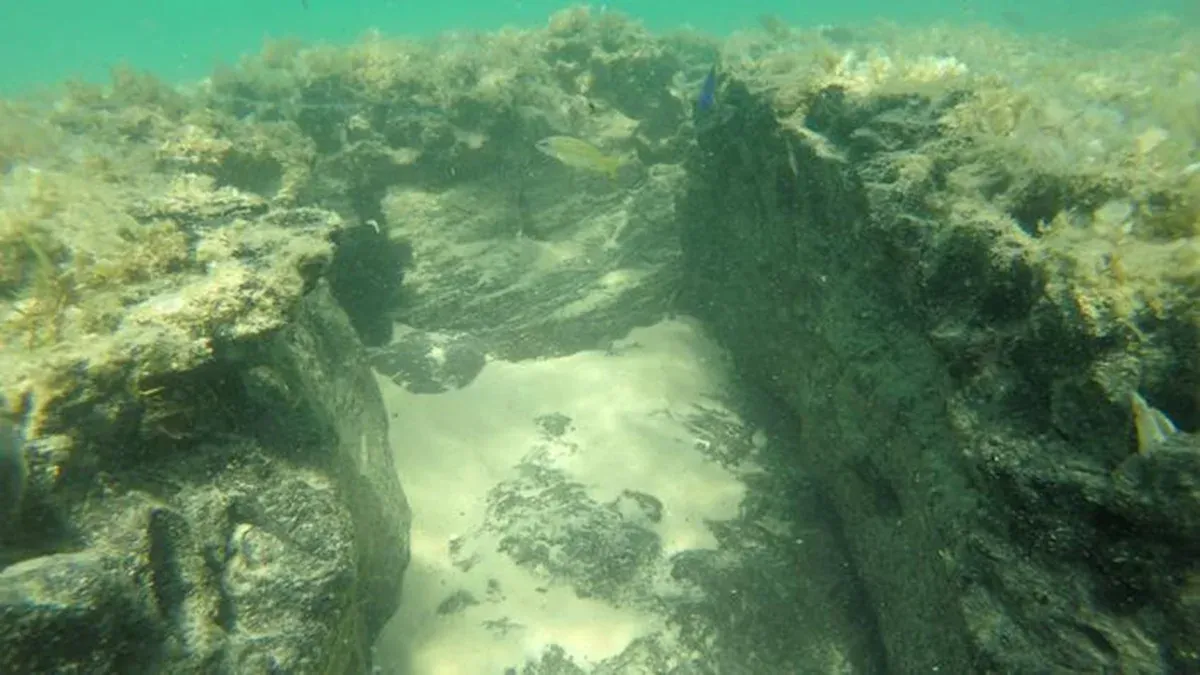
Drowned 5,000-year-old forests off Mozambique now shelter reef fish, no coral needed - Yahoo
Forests that stood on Mozambique's coast thousands of years ago now lie beneath shallow seas, and they have become fish-filled "peat reefs" with marine life comparable to coral reefs, researchers report in Scientific Reports. A team from the Bazaruto Center for Scientific Studies (BCSS) Ocean Observatory, led by Mario Lebrato, documented the submerged peat in the Bazaruto Archipelago in the Western Indian Ocean. BCSS, founded in 2017, describes itself as Africa's first permanent ocean observatory. Working with universities and institutions in the U. K., U. S. and Canada, the team believes it has carried out the first ecological study of peat reefs anywhere in the tropics. Old forests, new seafloorRadiocarbon dating shows the peat formed between about 300 and 5,000 years ago, and chemical analysis indicates it came mostly from coastal land plants and trees. Some samples contain up to 40% organic carbon by dry weight. Lebrato said the coastline has very little natural hard seabed, mostly shifting sand. As rising seas expose the old peat layers, they create rare solid habitat where marine life can settle, hide and feed.
0 comments
No comments yet. Be the first to share your thoughts!