Invisible burdens: reframing maternal mental health as a core priority in conflict-affected and low-resource settings - Frontiers
This story deserves to be shared
Send it to someone who'd care, or post it on your networks.

PERSPECTIVE articleFront. Glob. Women’s Health, 13 October 2026 Sec. Women's Mental HealthVolume 7 - 2026 | https://doi.org/10.3389/fgwh.2026.1989039AbstractMaternal mental health remains an overlooked dimension of global women's health, particularly in conflict-affected and low-resource settings where psychological distress is intensified by poverty, displacement, violence, gender inequality, and fragile health systems. Although maternal health agendas have achieved progress in reducing mortality, survival-focused approaches often fail to capture the psychological burdens that shape women's well-being, caregiving capacity, and intergenerational outcomes. This Perspective argues that maternal mental health should be reframed as a core component of maternal health rather than a secondary concern. Drawing on a life-course and gender-responsive perspective, we propose a conceptual framework linking conflict and structural inequality with social determinants, maternal psychological outcomes, and consequences for mothers and children.
This article is an excerpt. To read the full content, visit the original source. Frontiers
Related articles
Reframing epidemic early warning: toward AI-native decision intelligence for public health governance - Nature
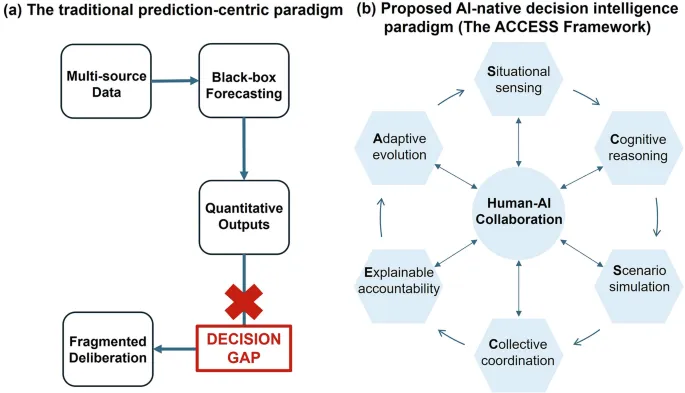
IntroductionEarly warning has long been regarded as a cornerstone of infectious disease surveillance and epidemic preparedness1,2. Substantial advances in epidemiological modeling, statistical inference, and data integration have improved outbreak detection and disease forecasting across diverse settings over recent decades3. Major public health emergencies, including SARS, influenza pandemics, COVID-19, and more recent emerging infectious diseases, have benefited from these developments in situational awareness4,5,6. Recent global health crises have, however, revealed a persistent limitation that we term the decision gap: technically sophisticated forecasts and risk indicators frequently fail to translate into timely, coordinated, context-sensitive action7,8,9. This gap has two linked faces: (1) Forecasts are often not decision-ready: they do not encode operational constraints, competing objectives, or uncertainty in usable form. (2) Institutions must still convert uncertain, evolving evidence into action through deliberation under legal and organizational constraints, a process current systems leave largely unsupported. This gap is not hypothetical.

Bioengineer.org | Viral blips during HIV therapy are common and rarely signal treatment failure, Swedish study finds - European AIDS Treatment Group
Bioengineer.org news storyFor people living with HIV, modern antiretroviral therapy can suppress the virus to levels below what standard laboratory tests can detect. Yet some patients on long-term treatment experience a curious phenomenon: a single test result showing a small, transient amount of virus in the blood, followed by an immediate return to undetectable levels. These events, known as viral blips, have puzzled clinicians and researchers for years, raising questions about whether they represent harmless statistical noise, brief bursts of viral production from hidden reservoirs, or early warnings of impending treatment failure. A new nationwide Swedish study, published in BMC Infectious Diseases, offers one of the most comprehensive answers to date. Drawing on the Swedish national InfCareHIV cohort, researchers analyzed data from 4,210 treatment-naïve adults who began antiretroviral therapy from 1 January 2007 onward, with follow-up data extracted through 30 September 2020. The median observation time was 5.5 years, with some individuals followed for as long as 13.7 years.
0 comments
No comments yet. Be the first to share your thoughts!