Inside the science and routine behind Maryland football’s strict nutrition regime - The Diamondback
This story deserves to be shared
Send it to someone who'd care, or post it on your networks.

Meal time isn’t taken lightly inside the Jones-Hill House.
Televisions line the building’s walls, flashing Maryland football’s weekly food schedule. On the door to the weight room fueling station, a sign is taped to the door with bold lettering: “BREAKFAST IS NOT OPTIONAL — IT IS A MANDATORY MEAL!!!!!!!!!!”
This article is an excerpt. To read the full content, visit the original source. The Diamondback
Related articles

Nebraska soccer draws with bottom-ranked Maryland - The Daily Nebraskan
Ten teams make the Women’s Soccer Big Ten Tournament in November. Nebraska soccer is currently on the outside looking in, ranked 12th. The Huskers drew 0-0 with the Terrapins on Oct. 8 in College Park, marking their fourth scoreless draw this season. Nebraska didn’t improve its postseason resume, as Maryland registered its first conference draw after starting Big Ten play 0-6. After facing five straight ranked opponents, the program's hardest stretch in history, the Huskers' competition eased as they faced the Terps, the Big Ten’s last ranked team. To make the postseason, Nebraska needed to win favorable matches going forward. It struggled to get shots on goal against the Terrapins. Before this game, Nebraska had lost the shot-total battle in four straight matches. NU only had two shots in the first half. In its last win, Nebraska defeated No. 20 Michigan on Sunday, Sept. 27, as sophomore midfielder Karli Williams found senior defender Reese Borer for a header to win in the final minutes. This match started back-and-forth, but the Huskers looked for Borer on two high-quality chances.

Simulations explore nuclear mitigation of asteroid threats - Phys.org
Lawrence Livermore National Laboratory researcher Isaiah Santistevan led the development of three-dimensional simulations exploring how a nuclear device could deflect or disrupt an asteroid threatening Earth. Credit: Blaise Douros/LLNL Lawrence Livermore National Laboratory (LLNL) researchers are developing three-dimensional simulations to examine how a nuclear device could be used to deflect or potentially disrupt an asteroid threatening Earth.

A Black Hole 12,000 Light-Years Away Is Firing a Plasma Jet Toward Earth - Gadget Review
Milky Way’s first microblazar candidate sits 12,000 light-years away, offering a rare ground-level lab for studying relativistic jetsA black hole 12,000 light-years away is firing a jet of plasma almost directly toward Earth. At that distance, no known or expected danger to Earth has been identified by the researchers or the institutions involved. What astronomers have actually found is rarer and more interesting than a threat. Researchers have identified IRAS 18293-0941 as a compelling candidate for the Milky Way’s first microblazar, a class of object that gives astrophysicists a close-up laboratory for studying some of the most violent physics in the galaxy. What Astronomers FoundThe discovery centers on a binary system whose black hole expels plasma jets at close to three-quarters the speed of light, pointed almost directly toward Earth. The system pairs a hot, massive star with a black hole that completes a full orbit roughly every 11.38 days. Material drawn from the companion star feeds the black hole, and some of that matter gets expelled outward as opposing jets traveling at approximately three-quarters the speed of light. Terminology matters here.
Drowned 5,000-year-old forests off Mozambique now shelter reef fish, no coral needed - Yahoo
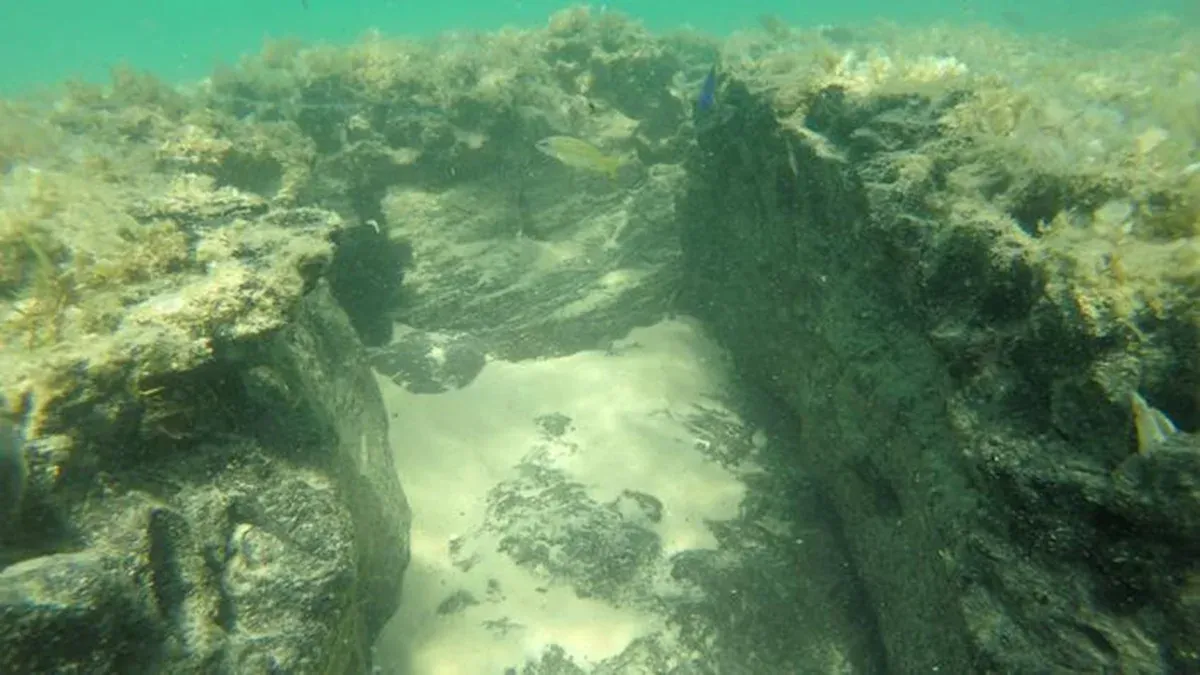
Forests that stood on Mozambique's coast thousands of years ago now lie beneath shallow seas, and they have become fish-filled "peat reefs" with marine life comparable to coral reefs, researchers report in Scientific Reports. A team from the Bazaruto Center for Scientific Studies (BCSS) Ocean Observatory, led by Mario Lebrato, documented the submerged peat in the Bazaruto Archipelago in the Western Indian Ocean. BCSS, founded in 2017, describes itself as Africa's first permanent ocean observatory. Working with universities and institutions in the U. K., U. S. and Canada, the team believes it has carried out the first ecological study of peat reefs anywhere in the tropics. Old forests, new seafloorRadiocarbon dating shows the peat formed between about 300 and 5,000 years ago, and chemical analysis indicates it came mostly from coastal land plants and trees. Some samples contain up to 40% organic carbon by dry weight. Lebrato said the coastline has very little natural hard seabed, mostly shifting sand. As rising seas expose the old peat layers, they create rare solid habitat where marine life can settle, hide and feed.
Coral Bleaching Reversed at Record Speed Using New Stanford Method: ‘Not a Lost Cause, at All’ - Good News Network
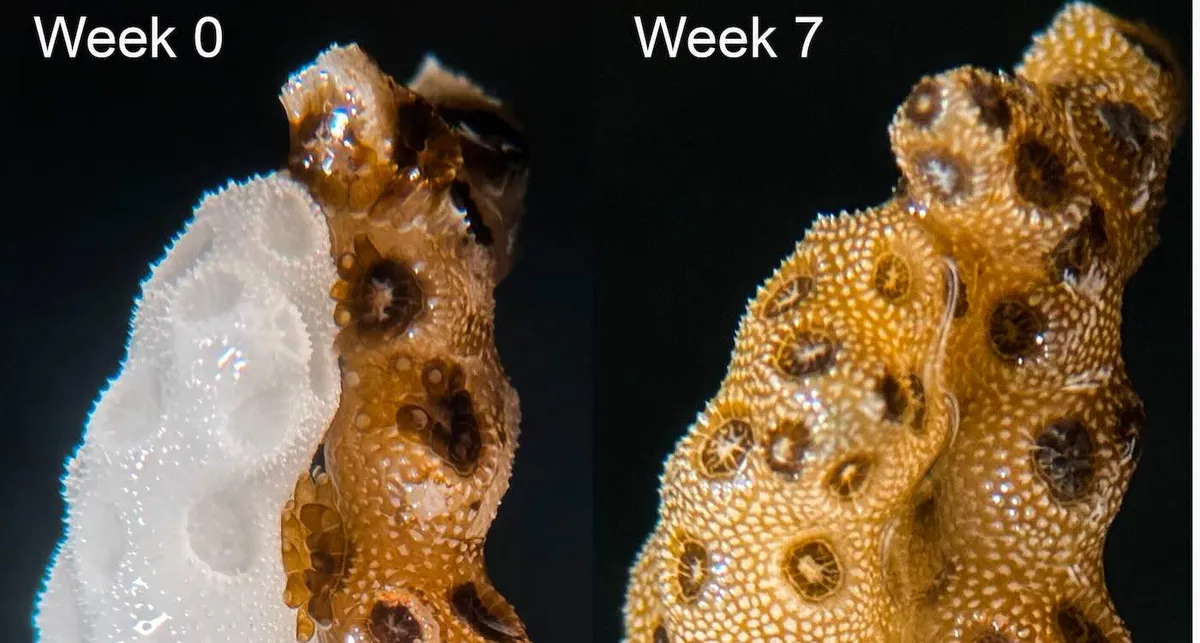
Coral bleaching restoration at Stanford – by Dan Griffin / GG Films (via SWNS, cropped) Coral bleaching has been reversed at record speed using a new method developed at Stanford University.
0 comments
No comments yet. Be the first to share your thoughts!