Honda Develops Underlaying Technology for In-motion Wireless Charging of EVs, Including Large Commercial Vehicles - Honda Global
This story deserves to be shared
Send it to someone who'd care, or post it on your networks.
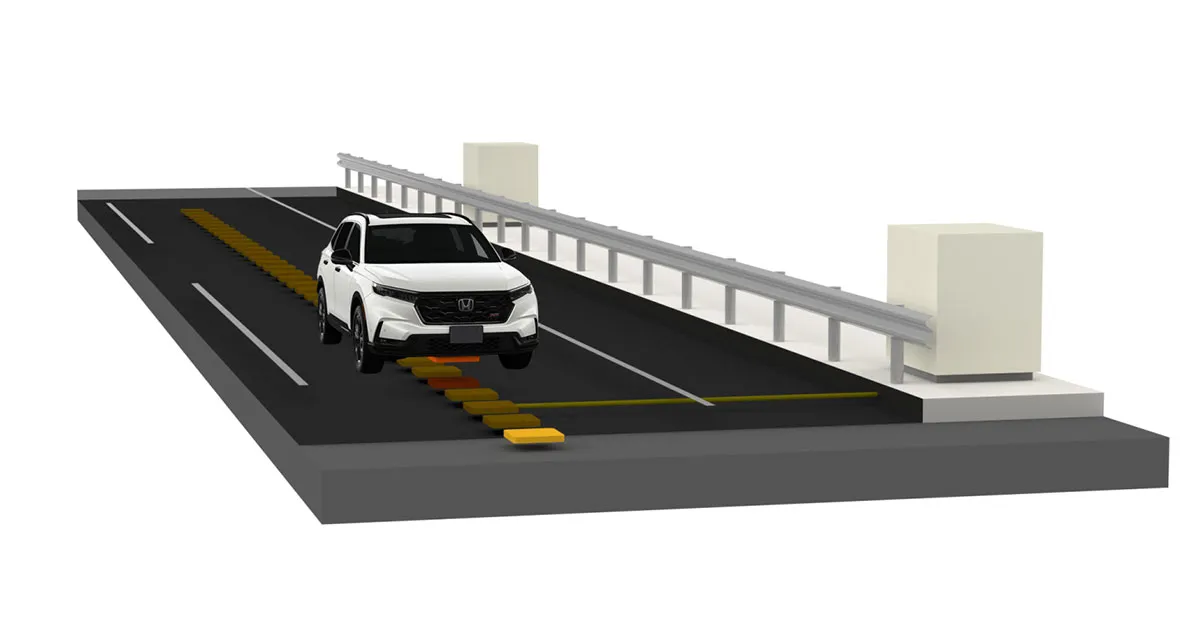
ー Advancing Joint Research with Taisei Group for Demonstration Testing on Public Roads of Magnetic Coupling Wireless Power Transfer Road System ー
TOKYO, Japan, October 5, 2026 – Honda R&D Co., Ltd., the R&D subsidiary of Honda Motor Co., Ltd., jointly with Taisei Corporation (Taisei) and Taisei Rotec Corporation (Taisei Rotec), has developed underlaying technology for a magnetic coupling wireless power transfer road system (“WPT road system”), which will enable wireless in-motion charging of EVs. The three companies are planning to conduct demonstration testing of the system from the Japanese 2027 fiscal year (starting April 1, 2027) onward.
This article is an excerpt. To read the full content, visit the original source. Honda Global
Related articles
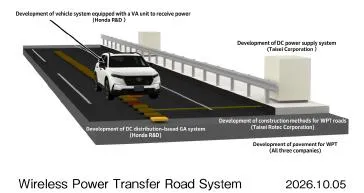
Honda Develops Underlaying Technology for In-motion Wireless Charging of EVs, Including Large Commercial Vehicles - Honda Newsroom
Honda R&D Co., Ltd., the R&D subsidiary of Honda Motor Co., Ltd., jointly with Taisei Corporation (Taisei) and Taisei Rotec Corporation (Taisei Rotec), has developed underlaying technology for a magnetic coupling wireless power transfer road system (“WPT road system”), which will enable wireless in-motion charging of EVs. The three companies are planning to conduct demonstration testing of the system from the Japanese 2027 fiscal year (starting April 1, 2027) onward. Honda R&D is working on this technology as one of the steps toward the realization of a next-generation mobility society where people can enjoy the freedom of mobility while also reducing the environmental impact of mobility products and services.
Rethinking wireless communications through formal mathematical AI reasoning - Nature
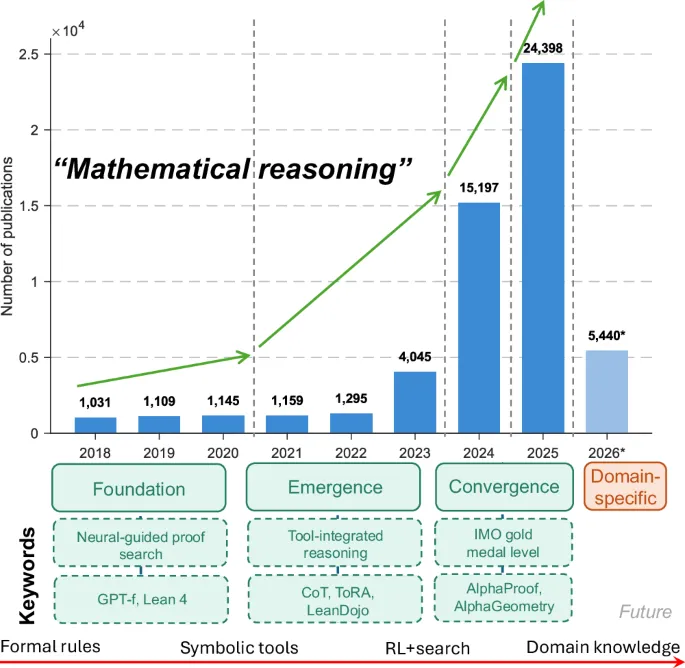
IntroductionIn 1948, Claude Shannon established the capacity of a noisy channel in a single landmark paper1, requiring little beyond probability theory and combinatorics. Nearly eight decades later, the mathematical foundations central to the design, evaluation and optimization of wireless systems have evolved profoundly. Characterizing the performance of massive multiple-input multiple-output (MIMO)2 calls for random matrix theory3, analyzing coverage in heterogeneous networks4 relies on Laplace functionals over spatial point processes5, and deriving the fundamental limits of integrated sensing and communication (ISAC)6 involves Fisher information structures that couple waveform design, channel statistics, and estimation theory7. Despite their critical importance in formulating diverse communication problems, solving them in next-generation wireless systems with growing complexity, dynamics, and heterogeneity can be extremely challenging. What unites these challenges is the depth and diversity of reasoning that they demand.
0 comments
No comments yet. Be the first to share your thoughts!