EXCLUSIVE: Congo’s Ebola epidemic started at least 4 months before it was detected - Science | AAAS
This story deserves to be shared
Send it to someone who'd care, or post it on your networks.
This article is an excerpt. To read the full content, visit the original source. Science | AAAS
Related articles

Should We Be Worried About a Russian 'Plague Epidemic'? Scientists Weigh in on The Risks. - ScienceAlert
A broken test tube is an unsettling image: shattered glass, spilled liquid, a dangerous bacterium suddenly outside its container. But in a laboratory designed to handle infectious organisms, that should not be where the protection ends. The death of a worker at Russia's Irkutsk Anti-Plague Research Institute has prompted speculation about a laboratory accident involving the bacterium that causes plague. Some reports describe a broken test tube. Russian authorities described her illness as pneumonia of unknown cause and denied a connection to pathogens handled at work. On 6 October, they reported that no plague cases had been detected among her contacts, Reuters reported. Neither plague as the cause of death nor the alleged laboratory accident has been independently established in the publicly available evidence. The concern reflects how quickly pneumonic plague can become life-threatening if untreated. "It is such a rapid and fatal infection that can kill within 24 hours," Brendan Wren, a professor at the London School of Hygiene & Tropical Medicine, tells ScienceAlert. The World Health Organization says early antibiotics can be effective.
Astronomers Have Detected A Mysterious Signal Coming From Empty Space. Nobody Knows What It Is. - ScienceAlert
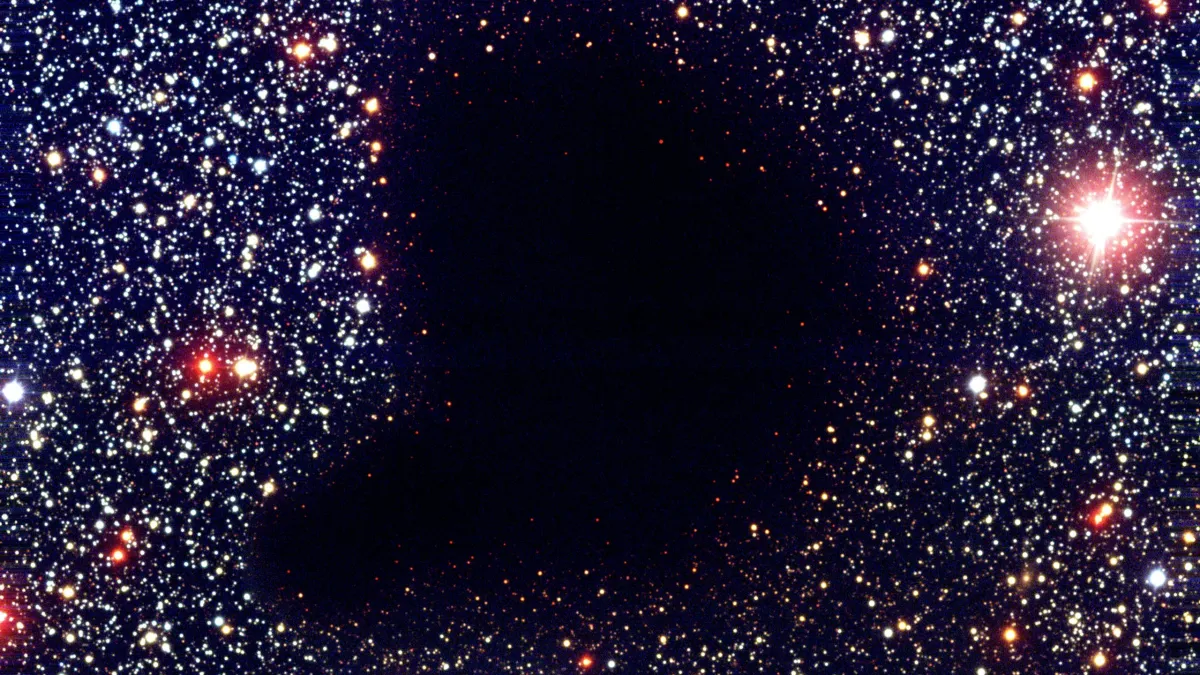
The dark nebula Barnard 68, a dense cloud of dust that blocks the light of stars behind it, creating the appearance of a hole in space. This is an illustrative image, not the location of the mysterious JWST detection. (ESO) In the southern constellation of Fornax lies a tiny patch of sky just like any other. Your eyes may have brushed past it a hundred times without a thought. Yet this otherwise unremarkable speck of the cosmos is among the most well-cataloged in the sky. The Hubble Space Telescope stared at it for more than 270 hours to obtain its famous Ultra Deep Field (HUDF) – and contained therein are nearly 10,000 galaxies extending billions of light-years into the Universe. When the James Webb Space Telescope (JWST) launched, it was only natural that its golden mirrors would turn to the same region of space, using its vastly more sensitive infrared capabilities to find what Hubble may have missed. Now, it has revealed that a patch of space astronomers have been poring over for decades may yet hold some surprises. In a tiny corner of the tiny field, JWST detected a strange signal – not once, but twice, in observations nearly three months apart. There's just one problem.
0 comments
No comments yet. Be the first to share your thoughts!