Engineered TYK2 dependence enables myeloid-selective IL-10 receptor agonism - Nature
This story deserves to be shared
Send it to someone who'd care, or post it on your networks.
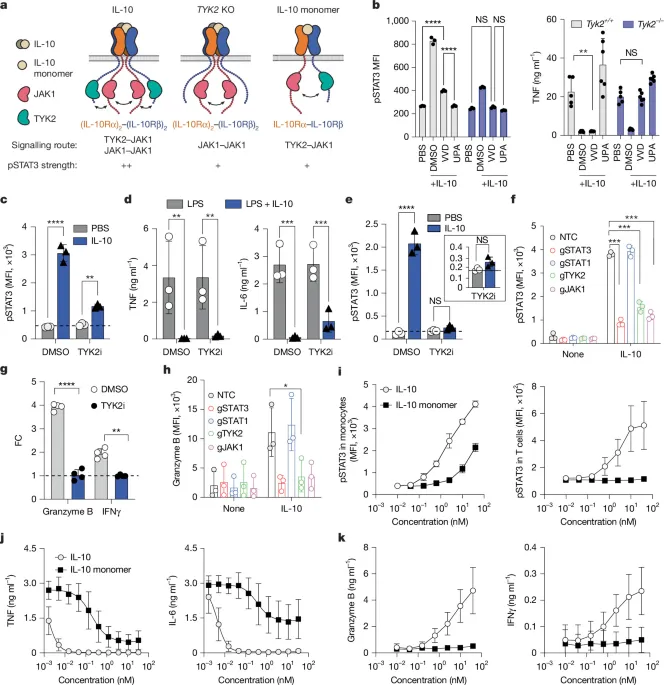
MainIL-10 is a potent anti-inflammatory cytokine that maintains immune tolerance1,6. Loss-of-function mutations in IL10 or its receptors IL10RA (encoding IL-10Rα) and IL10RB (encoding IL-10Rβ) cause early-onset inflammatory bowel disease (IBD) and autoinflammatory disorders1,7. IL-10 signalling is initiated when IL-10 binds to IL-10Rα and IL-10Rβ to form a tetrameric receptor complex, which is constitutively associated with Janus kinase 1 (JAK1) and tyrosine kinase 2 (TYK2), respectively1,8. This binding triggers JAK1-dependent phosphorylation of IL-10Rα and signal transducer and activator of transcription 3 (STAT3) to suppress pro-inflammatory gene expression and promote immune tolerance8,9. IL-10 primarily exerts its tolerogenic effects in myeloid cells and antigen-presenting cells, such as dendritic cells (DCs) and macrophages, by inhibiting cytokine production, antigen presentation and T cell priming5,10,11,12,13. Loss of IL10RA or STAT3 in these cells leads to colitis and systemic inflammation10,12,13. Despite its central role in immune tolerance, the dual functionality of IL-10 severely limits its therapeutic use6,14.
This article is an excerpt. To read the full content, visit the original source. Nature
Related articles
Patient-centered financial navigation assistance helps reduce financial toxicity among cancer patients - Medical Xpress
Among cancer patients, the high financial cost of cancer care is a prevalent problem. This financial burden is also associated with potentially harmful behavioral strategies that patients might use to cope with costs, such as delaying or forgoing treatment and skipping medications. Collectively, researchers refer to this impact as financial toxicity.

Continuous glucose monitors help type 2 diabetes patients spend 5 more hours a day in healthy blood sugar range - Medical Xpress
Continuous glucose monitors (CGMs) could transform diabetes management for millions of Americans with type 2 diabetes who don't take insulin, according to findings published in the New England Journal of Medicine. The clinical trial found that adults using CGMs spent approximately five additional hours each day within their target blood sugar range compared with those receiving routine care. Nearly twice as many CGM users also achieved an A1c level below 7%, a common treatment goal for people with diabetes.
Wearing headphones during surgery may reduce nausea and vomiting afterward - Medical Xpress
Patients who wore noise-canceling headphones during minimally invasive gynecological surgery were significantly less likely to experience postoperative nausea and vomiting (PONV), suggest findings from a randomized clinical trial presented at the Anesthesiology 2026 annual meeting.

Kefah Mokbel: Can Whole-Genome Sequencing-Based ctDNA Monitoring Help Personalize Adjuvant Treatment? - Oncodaily
“Beyond Detecting Cancer Recurrence: Can Whole-Genome Sequencing-Based ctDNA Monitoring Help Personalize Adjuvant Treatment? An exciting new study published in The Oncologist highlights the clinical potential of Signatera Genome, a whole-genome sequencing (WGS)-based, tumor-informed circulating tumor DNA (ctDNA) assay, not only for detecting molecular residual disease (MRD), but also for potentially informing adjuvant treatment decisions.
0 comments
No comments yet. Be the first to share your thoughts!