EES Departmental Seminar: The low-pressure metamorphic gradient along Nova Scotia’s South Shore, revisited - Dalhousie University
This story deserves to be shared
Send it to someone who'd care, or post it on your networks.

Title: The low-pressure metamorphic gradient along Nova Scotia’s South Shore, revisited
Abstract: In southwestern Nova Scotia, the metasedimentary rocks of the Meguma terrane exhibit a low-pressure metamorphic gradient from greenschist facies to migmatite in the Queens, Shelburne, and Yarmouth counties. These rocks were described and studied primarily in the 1980s and 1990s with few subsequent studies, leaving questions unanswered concerning their significance to the geological evolution of the Meguma terrane. Metamorphic grade has been observed to increase with proximity to granitoid plutons in this region, but the relative contributions of regional metamorphism vs. contact metamorphism have not been fully disentangled. My planned research program includes several projects in this area, beginning with migmatite and amphibolite-facies cordierite-bearing metapelites. Although a spatial association between migmatite and the Barrington Passage Pluton has been identified, a temporal link has not been established. We will conduct U-Pb geochronology by thermal ionization mass spectrometry (TIMS) to obtain high precision ages of migmatite leucosome and the Barrington Passage Pluton.
This article is an excerpt. To read the full content, visit the original source. Dalhousie University
Related articles
Imaging Science Seminar: Meeting in the Middle - When Radiologists and AI Are Both Uncertain - Rochester Institute of Technology
Artificial intelligence is increasingly being incorporated into radiology workflows, but both AI systems and human readers can be uncertain, inconsistent, or confidently wrong. Our work explores methods for quantifying and visualizing uncertainty in medical imaging AI, with the goal of making model outputs more interpretable and clinically useful. We are interested in how uncertainty-aware algorithms can help radiologists navigate difficult cases and improve consistency in settings with substantial inter-reader variability. This talk will discuss our efforts to better understand and ultimately improve the interaction between two imperfect decision-makers: the radiologist and the AI. David R. Holmes III, Ph. D. is a Professor of Biomedical Engineering at Mayo Clinic. He studies the methods by which healthcare researchers analyze and interpret large data sets. Dr. Holmes conducts his research from the perspective that data drives decisions.
Flying Rivers: ACTO Seminar Connects Science, Economics and Regional Cooperation - OTCA
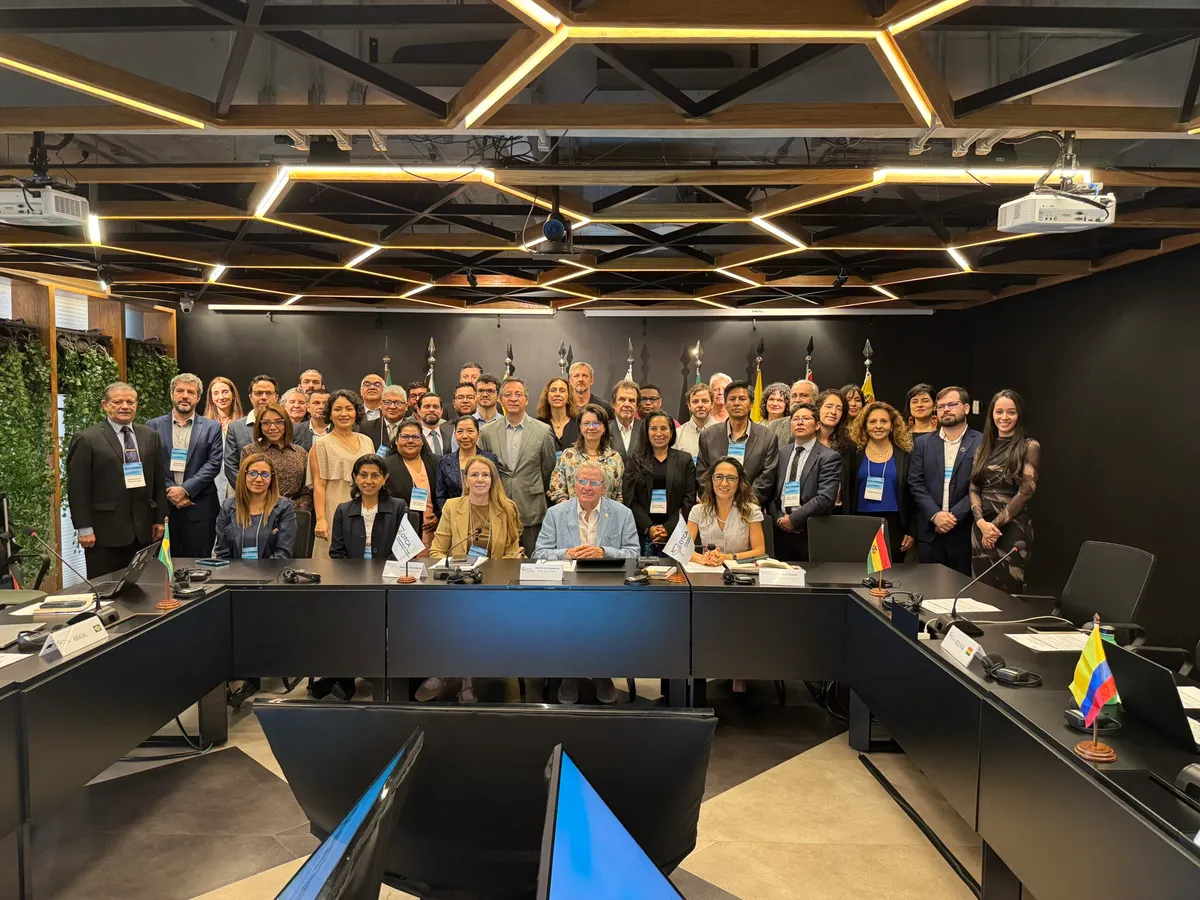
Expanding understanding of flying rivers and discussing how this knowledge can contribute to water security, decision-making and the valuation of Amazon ecosystem services was the focus of the Internal Seminar “Flying Rivers, Water Security and Economic Valuation of Amazon Ecosystem Services,” held on October 7 at the headquarters of the Permanent Secretariat of the Amazon Cooperation Treaty Organization (PS/ACTO) in Brasília. The event brought together experts in climate, hydrology, ecology and economics, representatives of ACTO Member Countries and partner institutions to discuss the state of knowledge on Amazonian moisture flows, the territories that depend on them and the economic value of the hydroclimatic services provided by the forest. Monitoring, governance, financing and opportunities for regional cooperation were also central to the discussions.
Chemistry Seminar Series: Ingo Krossing - University of Waterloo
XR SIG Seminar Canceled - NASA Science (.gov)
Chemistry Seminar Series: Marek B. Majewski - University of Waterloo

Simulations explore nuclear mitigation of asteroid threats - Phys.org
Lawrence Livermore National Laboratory researcher Isaiah Santistevan led the development of three-dimensional simulations exploring how a nuclear device could deflect or disrupt an asteroid threatening Earth. Credit: Blaise Douros/LLNL Lawrence Livermore National Laboratory (LLNL) researchers are developing three-dimensional simulations to examine how a nuclear device could be used to deflect or potentially disrupt an asteroid threatening Earth.
0 comments
No comments yet. Be the first to share your thoughts!