Earth is in the firing line of a strange new type of cosmic object: a 'microblazar' - Live Science
This story deserves to be shared
Send it to someone who'd care, or post it on your networks.
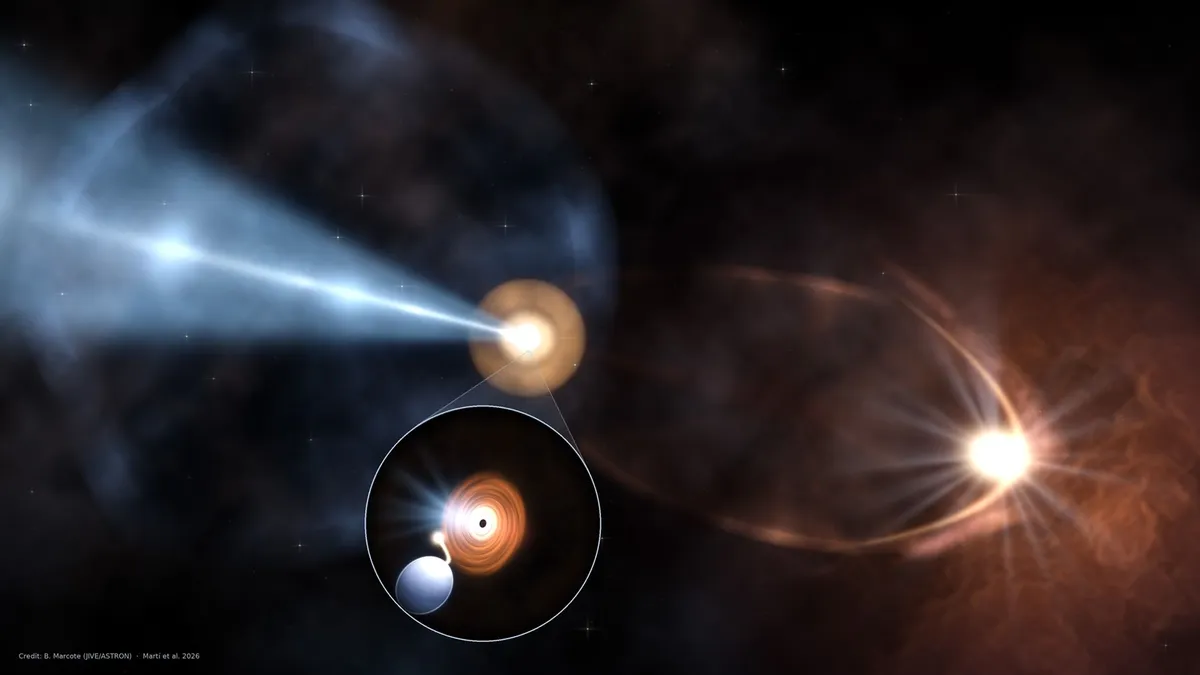
Astronomers may have discovered the first known microblazar, a long-theorized object firing a powerful beam of particles directly at Earth.
This article is an excerpt. To read the full content, visit the original source. Live Science
Related articles

A Black Hole 12,000 Light-Years Away Is Firing a Plasma Jet Toward Earth - Gadget Review
Milky Way’s first microblazar candidate sits 12,000 light-years away, offering a rare ground-level lab for studying relativistic jetsA black hole 12,000 light-years away is firing a jet of plasma almost directly toward Earth. At that distance, no known or expected danger to Earth has been identified by the researchers or the institutions involved. What astronomers have actually found is rarer and more interesting than a threat. Researchers have identified IRAS 18293-0941 as a compelling candidate for the Milky Way’s first microblazar, a class of object that gives astrophysicists a close-up laboratory for studying some of the most violent physics in the galaxy. What Astronomers FoundThe discovery centers on a binary system whose black hole expels plasma jets at close to three-quarters the speed of light, pointed almost directly toward Earth. The system pairs a hot, massive star with a black hole that completes a full orbit roughly every 11.38 days. Material drawn from the companion star feeds the black hole, and some of that matter gets expelled outward as opposing jets traveling at approximately three-quarters the speed of light. Terminology matters here.
For The First Time Ever, Quantum Spins Shift a Centimeter-Scale Object - ScienceAlert
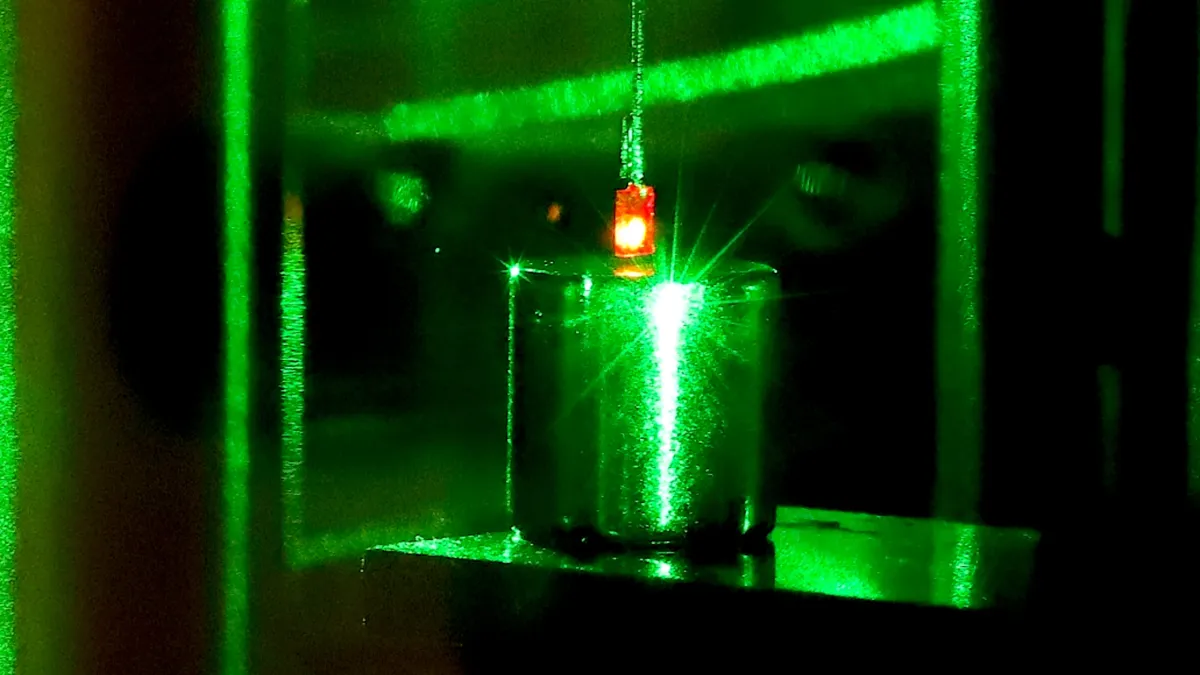
There's another notable first in the field of quantum physics to report on, and it's all to do with electron spin: the tiny, built-in magnetism of these particles, as if each one is carrying a microscopic compass needle. Previously, the force of these spins has only proved enough to nudge individual atoms in one direction or another. Now though, researchers have managed to shift something much, much bigger. A team from the Okinawa Institute of Science and Technology (OIST) in Japan has published a new study in Science Advances that details how a centimeter-sized object can be nudged by these quantum forces. It's an important step forward for science at the boundary of the quantum (very small scales) and the classical (everything else). Crucially, the experiment deals with an object big enough to be subject to gravity – a fundamental force that hasn't always sat well with the theories of quantum physics. "There have been many efforts to test whether quantum mechanics holds for anything larger than a few tens of nanometers, so far without success," says theoretical physicist Jason Twamley.
Object 24 | Drosophila Illustrations - Carnegie Science
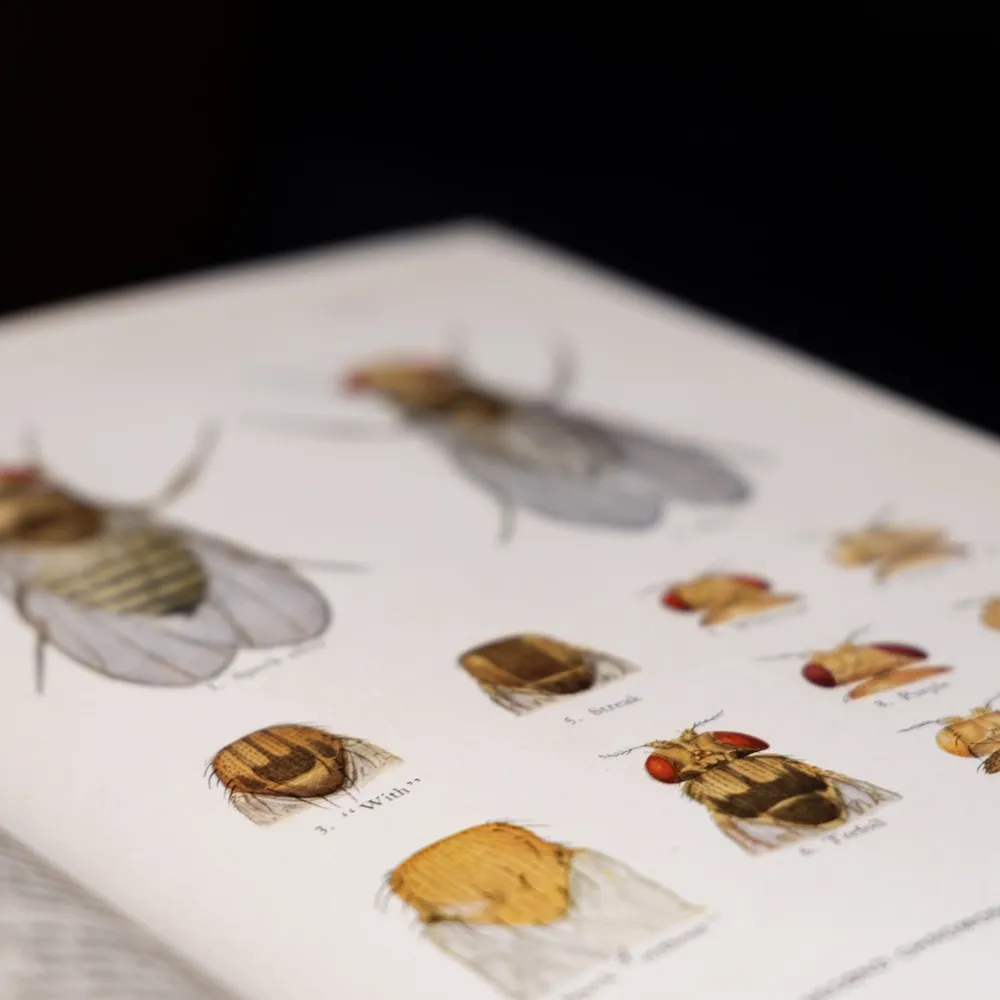
In the spring of 1910, Thomas Hunt Morgan peered into one of the hundreds of glass milk bottles that filled his cramped and famously messy laboratory at Columbia University and spotted something he had never before seen. Among the thousands of red-eyed fruit flies he had been breeding for nearly a year was a single male with white eyes. That one small fly was the first in a series of discoveries by Morgan and his team that would transform the study of heredity. Over the following decades, Morgan's "fly group" showed that genes are physical units lined up in a fixed order along chromosomes and that their positions could be mapped, laying the foundation of modern genetics. Carnegie Science made much of this research possible, providing sustained funding to the group from 1915 until 1945 and publishing its findings in a series of volumes, which were accompanied by exquisitely detailed ink drawings and watercolors of fruit flies by Edith Wallace, Morgan's technician and the team's artist. Her illustrations, representing the fly group’s work, are Object 24 in our #Carnegie125 series. Before the Flies Morgan was born into a prominent Kentucky family in 1866. After earning his Ph. D.
0 comments
No comments yet. Be the first to share your thoughts!