Computers Made of Human Brain Tissue Identify Braille Letters In Breakthrough - 404 Media
This story deserves to be shared
Send it to someone who'd care, or post it on your networks.
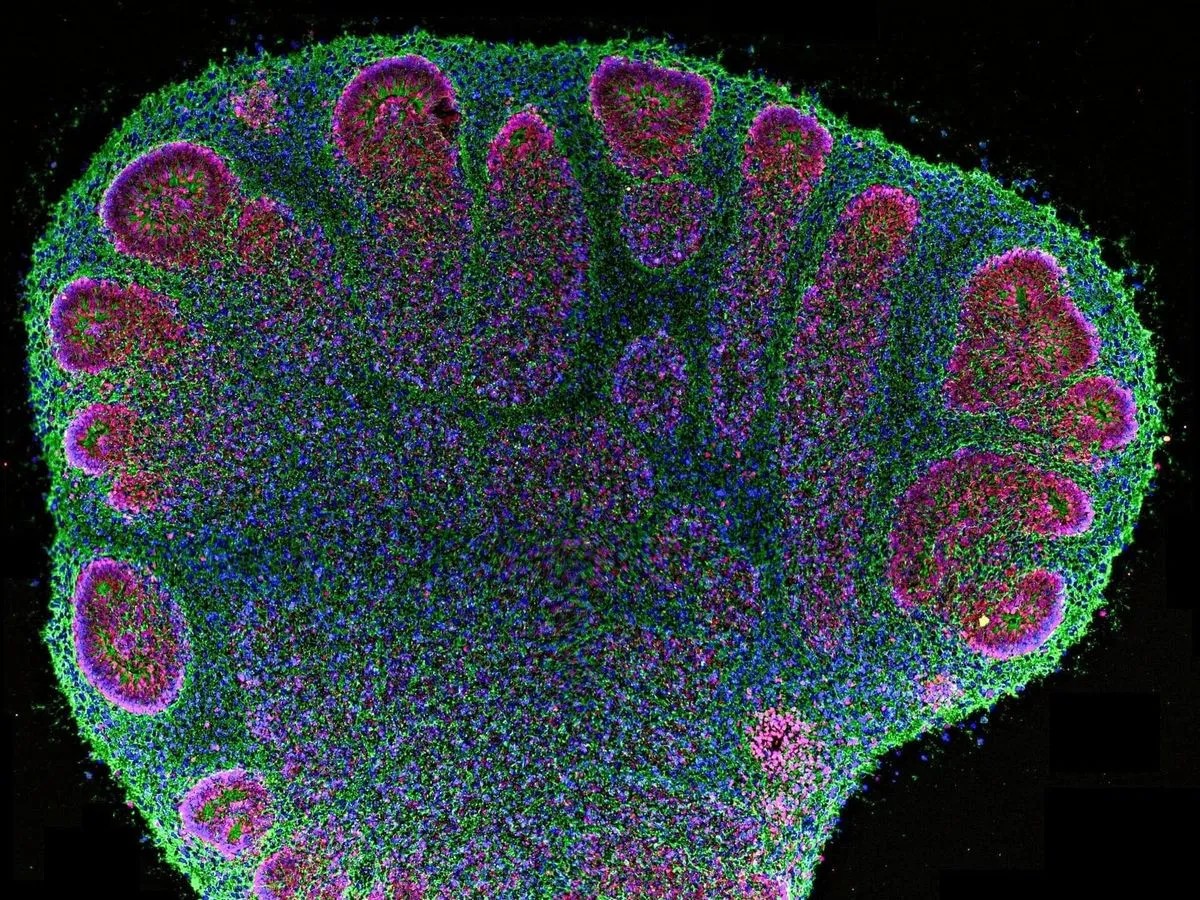
Scientists have made a breakthrough toward the mind-bending goal of creating computers made of brains by demonstrating that human neural tissue can classify letters of the Braille alphabet, according to a study published on Friday in Frontiers in Artificial Intelligence. A team transmitted electrical signals corresponding to Braille letters to human brain organoids, which are living neural tissues derived from stem cells. The results revealed that a single organoid, consisting of about 10,000 neurons, could classify the letters with about 61 percent accuracy, while teams of three organoids reached 83 percent accuracy. “The human brain can perform incredibly complex information processing while consuming relatively little energy, and artificial neural networks were originally inspired by biological nervous systems,” said Tianyi Liu, a PhD candidate at Bristol University who led the new study, in an email to 404 Media. “If we've been trying to imitate biological neural networks all along, why not try using real biological neural networks directly?” she continued. “What kind of information processing capabilities might these tiny neural organoids have?
This article is an excerpt. To read the full content, visit the original source. 404 Media
Related articles

No V12 Required: Argentina's Mid-Engine Supercar Packs An American V8 Punch - CarBuzz
Classic gems, tasteful customs, legendary supercars - for Silvian, they're all fair game. He's been in love with cars and motorcycles for as long as he can remember, so it made perfect sense to eventually turn that passion into a full-time writing career. Around six years and more than 3,000 articles later, he is still going strong and doesn't plan on hitting the brakes anytime soon. Argentina is a country known for its natural beauty, soccer legends, and chainsaw-wielding president, but it probably isn’t the first place you’d expect a rad V8 supercar to be developed. However, that assumption might change once you learn about a company called Valtor, the brainchild of engineer-turned-CEO Sergio Arias. He leads a small but ambitious team of designers and engineers like himself, who’d previously caught people’s attention with the Azor GT concept last year. Now they’re back at it once again with the Eaglon, an evolution of the Azor and something that could easily be mistaken for a Ferrari by those who don’t know their automotive lore.

Game developers cancel upcoming public demo out of fear of AI copycats - Mashable
There's currently some tension between the video game industry and the proliferation of AI tools. You can see the evidence of this in a recent development regarding the upcoming indie game Drunken Goddess Reflux. It's a game with the objective of imbibing alcohol until a demon vomits up her soul, a decidedly unique premise that would be hard for any AI to come up with. As spotted by Rock Paper Shotgun, though, the developers had to cancel an upcoming public demo session. The decision is partly due to concerns that AI could quickly clone it for someone else's financial benefit. Instead, they will hold closed sessions for a "limited number of participants. "

Slack Unveils Work Object Embeds for Seamless In-Thread Collaboration - Small Business Trends
In an era where time is money, small business owners constantly seek ways to streamline operations and enhance productivity. Recognizing this need, Slack has unveiled its latest feature: Work Object Embeds. This innovation allows users to bring live, interactive content directly into Slack conversations, eliminating the common hassle of constantly switching tabs and losing the flow of discussion. Work Object Embeds facilitate a seamless interaction within Slack by integrating tools and platforms that businesses may already rely on. When a team member shares a link from a supported application—be it a document, data analytics tool, or presentation software—it opens as a live and interactive piece of content directly in the conversation thread. This feature aims to keep discussions centered around the task at hand, enhancing collaboration across different team functions.
0 comments
No comments yet. Be the first to share your thoughts!