China reduced extreme poverty fast, but Indonesia hasn’t been far behind - Our World in Data
This story deserves to be shared
Send it to someone who'd care, or post it on your networks.
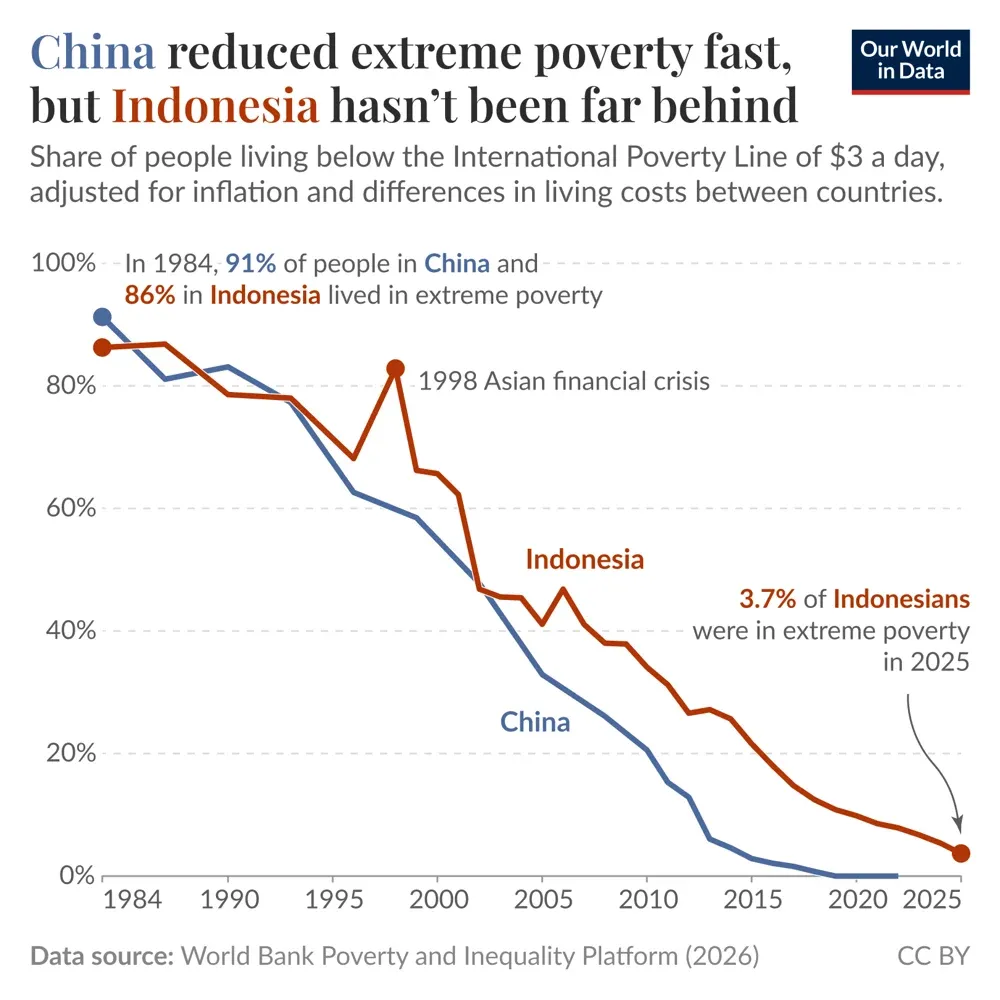
Data InsightsChina reduced extreme poverty fast, but Indonesia hasn’t been far behindOctober 13, 2026China is often the poster child for rapid reductions in poverty, and for good reason. In the early 1980s, over 90% of its population lived in extreme poverty, but by the early 2020s, that number had dropped to nearly zero. Some might assume that China is the only reason why global extreme poverty has declined. But that’s wrong: many countries have seen dramatic reductions in poverty, too. Indonesia is one clear example; it’s shown alongside China on the chart. In 1984, 86% of Indonesians lived on less than $3 per day. By 2025, this had fallen to less than 4%. While it didn’t quite match China’s decline, it has still been impressive. The number of people living in extreme poverty has fallen from 140 million to about 10 million. Note that the international poverty line is extremely low, defined as people living on less than $3 per day. But Indonesia has also made progress when measuring higher poverty lines.
This article is an excerpt. To read the full content, visit the original source. Our World in Data
Related articles
Rise in poverty is ‘a wake-up call for the world’, UN development chief says - UN News
The finding comes in the 2026 update of the global Multidimensional Poverty Index (MPI) published by the United Nations Development Programme (UNDP) and Oxford University, which measures overlapping hardship across health, education and standard of living. The 1.2 billion figure represents 51.5 million more people than in the 2025 update. Of this number, more than half are children – 617 million – and 83 per cent live in rural areas. ‘This is unacceptable’ “The rise in poverty should be a wake-up call for the world,” said UNDP Administrator Alexander De Croo. “Behind these figures are 1.2 billion people facing hardships that reinforce one another: hunger, missed schooling and a lack of clean water or electricity. This is unacceptable.” The index was developed in 2010 to measure poverty beyond what people earn. Overlapping deprivations It examines 10 indicators of health, education and standard of living, such as nutrition and child mortality, years of schooling, and access to electricity, drinking water and sanitation. A person is considered “multidimensionally poor” if they are deprived in one-third or more of the indicators.

Israeli settlers attack European diplomats during West Bank olive harvest - Al Jazeera
Israeli settlers have attacked European diplomats, including a French mayor, near the Palestinian village of Taybeh in the occupied West Bank. The delegation was visiting Palestinian olive harvesters on Saturday when the Israeli attackers confronted the group. The attack comes a day after settlers assaulted a US journalist north of Ramallah. In Saturday’s incident, the settlers targeted Belgium’s consul general, French and Polish diplomats and Catholic representatives, Belgian Foreign Minister Maxime Prevot said. “A French mayor was assaulted and a Belgian vehicle damaged,” Prevot said, linking the attack to what he called Israel’s “illegal settlement policy” and pledging to push for further European Union sanctions. French mayor Bernard Baudoux, who was assaulted, told the AFP news agency that the violence suggests that “there is a tolerance on the part of the Israeli government” towards settler violence. Al Jazeera’s Nour Odeh, reporting from Ramallah, said the settlers surrounded the diplomats’ vehicles, pelted them with stones and smashed their windows.
0 comments
No comments yet. Be the first to share your thoughts!