Brian Miller: The Blur at the Edges, Versus the Blur Everywhere - Science and Culture Today
This story deserves to be shared
Send it to someone who'd care, or post it on your networks.

Evidence for intelligent design in nature may be clear to you, while other matters relevant to faith remain far more perplexing. Our physicist colleague Brian Miller talked with Jana Harmon on the eX-skeptic podcast, in a very personal conversation, and offered a helpful analogy. He agreed that, for him, there are “tensions” and “unanswered questions.”
But here’s the difference. When you have, let’s say, a magnifying glass and you use that magnifying glass to see the small print on your medicine bottle, what happens is that [with the] magnifying glass, what’s in the center is very clear.
This article is an excerpt. To read the full content, visit the original source. Science and Culture Today
Related articles
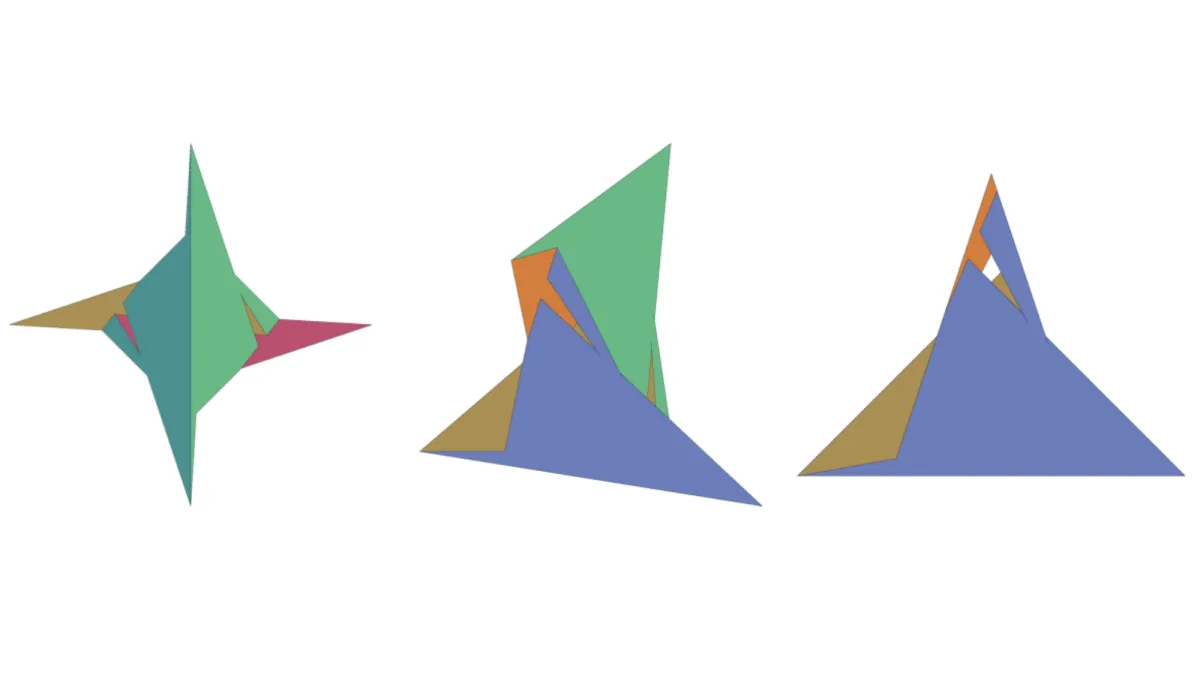
Mathematician creates new shape with 8 sides, 26 edges, and 3 holes - Popular Science
The genus-3 polyhedron is what's known as a toroidal polytope. It may be hard to believe, but mathematicians are still discovering shapes. The latest three-dimensional example is far stranger than your standard cube or pyramid. Dubbed the genus-3 polyhedron by Ruslan Mizhaev, the independent researcher’s newly identified shape features eight faces arranged so that every pair shares at least one edge. The end result is an oddity with 26 edges and 24 vertices, with 20 face pairs sharing a single edge while eight others share two faces. And as if the concept wasn’t headspinning enough, three faces meet at every vertex.

ArXiv versus AI slop: will capping preprint submissions work? - Nature
Some preprint servers report being flooded with submissions. Credit: Michael Szebor/NatureIn a bid to tackle the deluge of manuscripts it now receives, the preprint server arXiv has announced a cap of two papers per month for each submitting researcher, which began on 1 October. The move follows a steep rise in submissions driven mainly by the slop generated by artificial-intelligence tools, says Steinn Sigurðsson, an astrophysicist at Pennsylvania State University in University Park and scientific director of arXiv. In September, 40,000 preprints were uploaded to arXiv, up from about 30,000 between March and July. Closing the floodgates The cap is the latest measure introduced by arXiv to prevent its nearly 300 voluntary moderators from being completely overwhelmed by submissions, says Sigurðsson. They are now collectively checking about 1,000 manuscripts per day. This step is “holding up too many legitimate papers,” Sigurðsson says, noting that nearly 4,000 submissions are currently waiting to be posted on the site. Some see the limit as entirely reasonable.
KV the Apostate: Faith-Based Computing Versus the Unnatural Science - Communications of the ACM

What the puff is that? Huge ball-like mushrooms sprouting up everywhere - Yahoo News Canada
The scientific term for these huge puffballs is Calvatia Gigantea, which translates from Latin as "giant bald head"—exactly what they resemble. They appear in late summer and fall and like many mushrooms, they grow after a good rain. The huge mushrooms may grow anywhere there is organic matter, including forests, lawns and golf courses. They are common across Canada, particularly in Ontario, Quebec and British Columbia. "They do tend to show up in the fall like a lot of mushrooms actually. That's because they kind of show up when conditions of the humidity accumulates and then the nights start being a little cooler. Then this kind of combination of humidity, cool nights and then some warm days then you get these you know these mushrooms are popping out," said Richard Hamelin, a professor at the University of British Columbia in the faculty of forestry and environmental stewardship. DON'T MISS: How the weather is influecing your music tasteThese mushrooms are ones you can eat, but Hamelin cautions amateur foragers.
0 comments
No comments yet. Be the first to share your thoughts!