An aging-sensitive secreted phospholipase confers neuroprotection and cognitive resilience - Nature
This story deserves to be shared
Send it to someone who'd care, or post it on your networks.
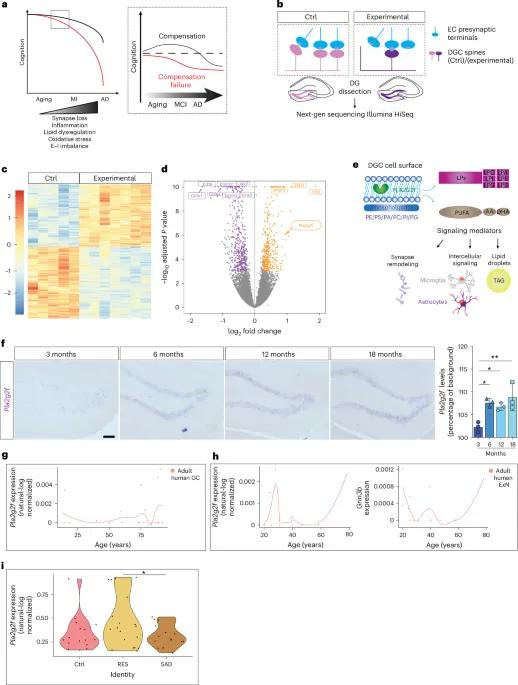
MainThe hippocampus plays a crucial role in the registration of our experiences as episodic memories and includes the dentate gyrus (DG) subregion that contributes to memory formation by decreasing memory interference1. Furthermore, dysfunction in DG is considered to be a primary driver of aging-associated cognitive decline and a hallmark of mild cognitive impairment (MCI)2. Healthy cognitive aging depends on a balance of resilience and vulnerability factors that dictate the tempo of pathophysiological alterations, such as synapse loss3,4, lipid dysregulation5,6,7,8,9, emergence of maladaptive ‘inflammatory’ microglia6,10,11 and reactive astrogliosis12,13, oxidative stress14,15, loss of hippocampal neurogenesis16, and excitation–inhibition imbalance2,17,18. Disruption of this balance leads to a trajectory of cognitive decline and increased risk for MCI and Alzheimer’s disease (AD). A complementary perspective, first offered within the framework of cognitive reserve theory, posits that pathological cognitive decline reflects a failure to compensate for the progressive increase in pathophysiological alterations over time19 (Fig. 1a).
This article is an excerpt. To read the full content, visit the original source. Nature
Related articles
Why humans are ‘uniquely sensitive’ to wildfire smoke - Faculty of Health Sciences - McMaster University

Continuous glucose monitors help type 2 diabetes patients spend 5 more hours a day in healthy blood sugar range - Medical Xpress
Continuous glucose monitors (CGMs) could transform diabetes management for millions of Americans with type 2 diabetes who don't take insulin, according to findings published in the New England Journal of Medicine. The clinical trial found that adults using CGMs spent approximately five additional hours each day within their target blood sugar range compared with those receiving routine care. Nearly twice as many CGM users also achieved an A1c level below 7%, a common treatment goal for people with diabetes.
0 comments
No comments yet. Be the first to share your thoughts!