A RAG-enhanced multi-agent LLM/VLM framework for auditable and region-aware structural health monitoring of a historic masonry structure - Nature
This story deserves to be shared
Send it to someone who'd care, or post it on your networks.
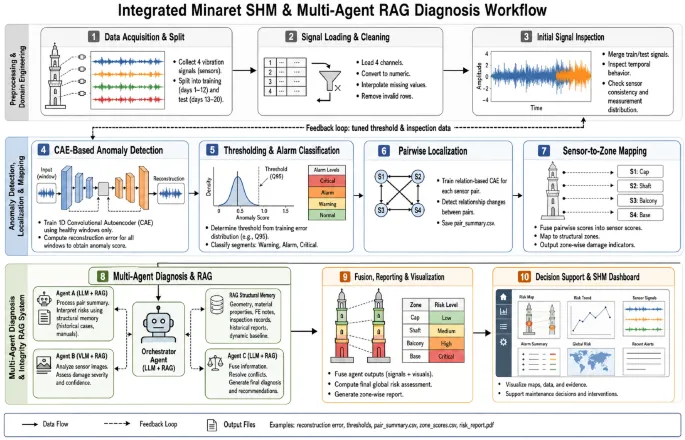
IntroductionHistoric masonry minarets are slender, tall structures that embody cultural identity while remaining vulnerable to progressive deterioration and sudden hazards1,2. Aging mortar, material heterogeneity, environmental exposure, nearby construction, and seismic activity can introduce cracks, detachments, and out-of-plane deformations that are difficult to detect early, especially when access is limited and interventions must be minimally invasive. Structural health monitoring (SHM) for such heritage assets therefore benefits from non-contact sensing and data-driven inference that can operate continuously, localize damage, and provide interpretable evidence to support conservation decisions. For tall, slender masonry forms, monitoring is additionally complicated by geometric discontinuities (e.g., balconies, openings, and transitions), spatially varying material properties, and complex soil–structure interaction, all of which can concentrate damage and alter dynamic response over time3,4,5.
This article is an excerpt. To read the full content, visit the original source. Nature
Related articles

Alcohol Doesn't Just Affect Neurons – It Triggers Immune Cells to Destroy The Brain's Structural Matrix, Mouse Study Shows - ScienceAlert
It's well known that alcohol has profound consequences on the way the brain works, and research shows that even low levels of the drug can damage your brain. But how does alcohol actually cause brain damage at the cellular level? In a surprising discovery reported in Immunity, scientists found that alcohol doesn't just interact with neurons. New findings show the drug also affects immune cells in the brain called microglia, triggering them to dismantle the extracellular matrix that structurally supports brain cells. "For years, alcohol's effects on the brain were largely viewed through the lens of neurons, and for good reason: alcohol acts directly on neuronal receptors," says neuroscientist and senior author of the study Dimitrios Davalos from the Cleveland Clinic. "By following microglia in real time, we were able to see that they aren't simply responding to damage. They drive the detrimental changes alcohol causes in the brain. "Experiments showing how alcohol use negatively affects the brain's microglia immune cells over time.

Only structural change will fix NZ’s glaring health equity gap – what voters should know - The Conversation
The performance of New Zealand’s health system – from hospital staffing and resourcing to access to primary care and general practitioners – is a key election battleground once more. Around 200,000 people, half of them Māori, have no GP. In the 2024-25 New Zealand Health Survey, one in seven adults (14.9%) reported not visiting a GP due to cost (25.1% for Pacific adults, 18.7% for Māori).

When LLM Gateways Go Wrong: Findings from LiteLLM - Check Point Research
Our security assessment of LiteLLM (v1.77.7), a widely used open-source LLM gateway, uncovered multiple high-impact vulnerabilities (tracked as CVE-2026-35029, CVE-2026-59823) which have been resolved as of LiteLLM version 1.83.9. The most significant issues stemmed from a missing authorization check on the /config/update endpoint, which allowed any authenticated user (including low-privileged accounts) to modify the proxy’s runtime configuration. This single flaw enabled arbitrary file read, administrative account takeover, and remote code execution via malicious Python modules loaded from cloud storage. A separate SSRF vulnerability in the “Clientside LLM Credentials” feature allowed attackers to redirect API calls and exfiltrate provider keys. These findings highlight that as AI infrastructure tools rapidly evolve, foundational security practices like proper access control and input validation remain essential.
Patient-centered financial navigation assistance helps reduce financial toxicity among cancer patients - Medical Xpress
Among cancer patients, the high financial cost of cancer care is a prevalent problem. This financial burden is also associated with potentially harmful behavioral strategies that patients might use to cope with costs, such as delaying or forgoing treatment and skipping medications. Collectively, researchers refer to this impact as financial toxicity.
0 comments
No comments yet. Be the first to share your thoughts!