A Little Fish in The Deep Sea Swallowed a Meal Way Bigger Than Itself. Scientists Caught It on Camera. - ScienceAlert
This story deserves to be shared
Send it to someone who'd care, or post it on your networks.
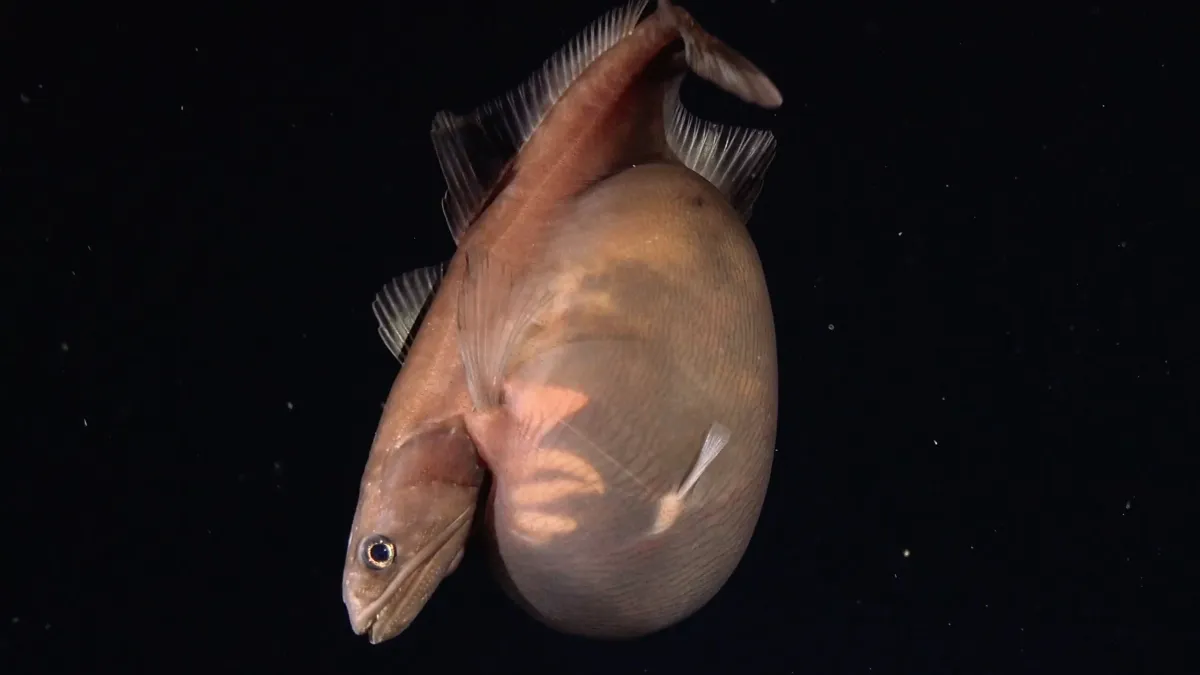
There's always a bigger fish in the sea. For most of us, that idiom is a warning – but for one little swimmer in the deep, it's a blessing. The black swallower fish (Chiasmodon niger) is a little creature that grows, on average, just 10-20 centimeters (3.9–7.9 in) long, and no more than a school ruler. Still, that doesn't stop it from aiming high. This unassuming fish can gulp down prey up to ten times its mass. It's an underdog moment for sure – like if David ate Goliath – and in a spectacularly rare event, scientists just captured it on camera. During a recent deep-sea dive near the islands of Trinidad and Tobago, a remotely operated vehicle snapped a black swallower fish at 1,259 meters deep, lugging around a stomach so distended it looks like a sidecar. The skin is stretched almost transparent, to the point where you can actually see its internal organs and intestines. "[Black swallower fish] are notoriously rare to spot in the wild. I saw my first nearly a decade ago in the Gulf of Mexico," says Diva Amon from the Schmidt Ocean Institute, the chief scientist of the expedition. "I never imagined I'd get a second chance. But this expedition delivered BIG.
This article is an excerpt. To read the full content, visit the original source. ScienceAlert
Related articles
Physicists Built a Black Hole in a Lab. Then It Swallowed Sound. - ScienceAlert
Sound can be a tricksy beast to try to harness. It fills the world around us, bursting from its multitudinous sources, bouncing off surfaces as echoes – a property that makes sound both incredibly useful and deeply vexing, depending on where and how its reverberations occur. There are some circumstances where echoes can cause problems. The most obvious example is sound recording studios, but one major problem area is probably less obvious because it's far more ubiquitous – pipes. Consider ventilation, air conditioning, industrial exhaust, or even plumbing. Sound travels through the spaces enclosed in those pipes and ducts, and when it encounters an obstruction, a change in shape, or a closed end, it can start to rattle around like nobody's business. Now, scientists have developed an ingenious little device that can dramatically reduce those reflections by effectively 'swallowing' sound. It's called a sonic black hole, and the new design can be 3D-printed and inserted directly into an existing pipe – a major step forward from conventional designs that require the black hole to be built into the pipe itself.

Astronomers Just Found the First Green Star Ever Discovered—Right After It Swallowed Its Planets - Gizmodo
When we look up at the Sun, we see a star glowing in shades of yellow, orange, and white. Across the universe, stars display a range of colors, from fiery reds to brilliant blues, with their hues shaped primarily by their surface temperatures. But what if the stellar palette extends beyond the colors we’re accustomed to seeing? New findings are bringing some unexpected possibilities into view, suggesting that white dwarfs, the dense remnants of dead stars, could glow in shades of pink, purple, and even green. For the first time, astronomers have spotted a star that appears green to the human eye. The star had reached the end of its lifespan and swallowed up rocky material from its planetary system, giving it a chartreuse green appearance. The findings, published in RAS Technique and Instruments, suggest that planetary debris can cause white dwarf stars to shine in a whole array of colors if viewed up close. Zombie star When a star like the Sun burns through its nuclear fuel, it sheds its outer layers to form a planetary nebula, leaving behind its dense, dead core in the center.

SpaceX Sent 6,300 Pounds to the Space Station. The Strangest Cargo Was Grown in a Lab - Inc.com
The spacecraft delivered materials and equipment for new research studies to the station.

Ancient mud reveals a surprising secret about Greenland’s ice - Earth.com
Mud from a fjord shows an Atlantic air pattern brought wetter, colder spells to southern Greenland, a clue to how its ice may fare. Greenland’s ice is shrinking as the planet warms. But in the island’s southwest, rainfall and snowfall have been influenced by the same North Atlantic air-pressure pattern for at least 5,000 years. When that pattern tipped one way, the region turned wetter and colder. The record comes from mud on the floor of a Greenland fjord, and it suggests snowfall, not only temperature, shaped how the area’s ice grew and shrank. It doesn’t yet show how glaciers there will respond to the warming ahead. Johan Faust, a researcher at MARUM, the Center for Marine Environmental Sciences at the University of Bremen in Germany, led the work with colleagues in Germany, Norway, Denmark and Canada. A seesaw in the airThe pattern is called the North Atlantic Oscillation. It’s the difference in air pressure between a low that sits near Iceland and a high near the Azores, and it’s strongest in winter. When that difference is large, the pattern is in its positive phase. Northwestern Europe and southwestern Greenland both get more rain and snow.

Simulations explore nuclear mitigation of asteroid threats - Phys.org
Lawrence Livermore National Laboratory researcher Isaiah Santistevan led the development of three-dimensional simulations exploring how a nuclear device could deflect or disrupt an asteroid threatening Earth. Credit: Blaise Douros/LLNL Lawrence Livermore National Laboratory (LLNL) researchers are developing three-dimensional simulations to examine how a nuclear device could be used to deflect or potentially disrupt an asteroid threatening Earth.
0 comments
No comments yet. Be the first to share your thoughts!